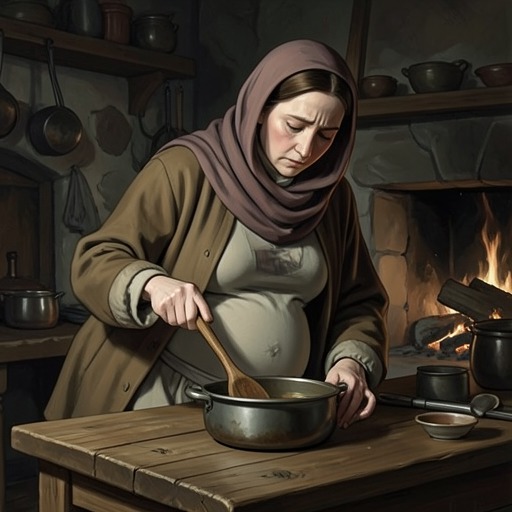
Hanka’s pregnancy
The PeasantsHanka’s pregnancy is registered not as background information but as a physical condition that interrupts ordinary life: she feels the child moving, grows faint, and eventually collapses in the cottage. Jagustynka’s alarm at the possibility that the birth might come too early makes the danger explicit, although the scenes do not establish that labor begins or reveal what happens to the pregnancy afterward.
Bodily Signs and Immediate Concern
The clearest account comes when Jagustynka quietly asks Hanka whether she seems unwell after the previous day. Hanka answers that the baby is moving and kicking continually and that she feels faint. Her report is brief, but it gives the pregnancy a persistent, active presence: the movement is not a distant prospect of motherhood but something she experiences in her body at that moment. The accompanying faintness makes the exchange more than a routine confirmation of her condition. Jagustynka responds with practical concern. She tells Hanka to lie down and recommends an infusion of hemp, attributing her weakness to having been badly shaken the day before. This is the older woman’s interpretation and advice, not a medical diagnosis supplied by the narration. Her concern nonetheless establishes that Hanka’s condition is visible enough to prompt care, and that the women around her understand both physical strain and the possibility of a pregnancy-related emergency through immediate observation and household remedies.
Collapse in the Cottage
The danger becomes more pronounced during a conversation about village affairs. After hearing news of the squire’s anger and Kozłowa’s threats, Jagustynka remarks that even the poorest may find a vulnerable point. She breaks off when Hanka slides down the wall and rushes to catch her. The abrupt turn from public troubles to a bodily crisis gives the pregnancy a force that village disputes cannot contain: discussion stops because Hanka’s condition demands immediate attention. Jagustynka fears that the birth may come too soon. Hanka is unconscious, barely breathing, and her face is marked by yellow patches and beads of sweat. Jagustynka rubs her temples with vinegar and holds horseradish under her nose; only then does Hanka recover consciousness, opening her eyes and hiccuping. These concrete details make the collapse alarming without identifying its cause. The passage does not say that premature labor has begun, nor does it provide a lasting diagnosis or describe a subsequent birth. Its evidence is narrower: Hanka is pregnant, physically unwell, and in a moment of serious distress, while Jagustynka fears for her.
Care Amid Ordinary Life
The scenes place this vulnerability within the communal rhythm of Easter and household work. The village is lively with the boys’ water-dousing, while residents complain about the disturbance and return to the cottage. Jagustynka’s concern for Hanka unfolds amid these everyday activities rather than in a separate account devoted solely to pregnancy. Even after helping her recover, the older woman joins the others at breakfast and urges Hanka to eat, treating food and rest as immediate matters of care. The juxtaposition does not make the danger trivial; it shows how attention to illness and pregnancy is woven into the same domestic routine as meals, clothing, and chores. After the collapse, the others go off to do their chores, leaving Witek behind. He asks his mistress to let him go out with the cockerel, and she permits him to leave with instructions to behave and to tie up the dogs. The passage returns quickly to ordinary household management, but Hanka’s fainting has already altered the tone of the scene. Her pregnancy is not elaborated through a long account of her thoughts; it is conveyed through what she says, what happens to her body, and the immediate response of the people nearby.
Narrative Limits and Significance
Taken together, the moments establish a condition with real stakes but an open outcome. The child’s repeated movement, Hanka’s faintness, and her collapse prevent the pregnancy from remaining an abstract plot fact. Jagustynka’s fear of an early birth sharpens the uncertainty, while her improvised care makes the women’s response central to the episode. Yet the account does not confirm that Hanka gives birth in this sequence, identify the cause of her collapse, or state the later fate of the pregnancy. That restraint matters: the evidence presents bodily risk and communal care without resolving them, leaving Hanka’s pregnancy as a vulnerable state rather than a completed event.